Last Updated: October 28, 2026
Quick Summary
New build homes in dallas in Texas include quick move-in homes from builder inventory, spec homes in builder communities, and custom builds on your own land. Newly built homes made up 31% of Dallas-Fort Worth listings in the first half of 2026, so compare contract terms, change orders, and warranty coverage before you sign.
- Newly built homes were 31% of Dallas-Fort Worth listings in the first half of 2026.
- ConsumerAffairs reported 11,327 permitted housing units and 3,009 new-home sales for Dallas in early 2026.
- Macrotrends recorded 4,598 new-home permits in August 2026 for the Dallas area.
- A pre-drywall walkthrough happens after rough-in but before drywall, when framing and mechanicals are visible.
- FGI Homes backs its work with a 1-2-10 builder warranty covering workmanship, mechanical systems, and structure.
Table of Contents
- What New Build Homes in Dallas Actually Include
- Custom Home Building Process: From Land to Final Walkthrough
- What Drives Cost in New Construction Homes
- How Long Does It Take to Build a Custom Home?
- Questions to Ask a Home Builder Before You Sign
- Your New Construction Home Checklist
- Comparing Builders, Communities, and Home Specifications
- Applying for a Private Consultation
- Frequently Asked Questions
What New Build Homes in Dallas Actually Include
New build homes in dallas in Texas cover a wider range of options than most buyers expect. Newly built homes made up 31% of Dallas-Fort Worth listings during the first half of 2026, according to a Realtor.com report cited by MetroTex. That share explains why the search feels crowded. This guide from FGI Homes breaks down what you are actually choosing between, what drives cost, and the questions worth asking before you sign anything.
"New construction" is not one product. A quick move-in home is finished or nearly finished and sold from builder inventory. A custom build on your own land is designed around your lot and plans. A spec home in a builder community sits in between. Each comes with a different contract, timeline, and set of risks.
New construction is the process of building a home that has never been occupied, whether from a production builder's existing plan set or from a fully custom design.
Dallas City Versus the Wider DFW Metro
Market data usually describes the metro, not the city. ConsumerAffairs reported 11,327 permitted housing units and 3,009 new-home sales for Dallas in early 2026, and described Dallas as leading the nation in new-home activity (ConsumerAffairs new-construction cities report). Those figures cover a broad footprint.
Permitting tells the same story at a different scale. Macrotrends recorded 4,598 new-home permits in August 2026 for the Dallas area, with a 2026 year-to-date average of 5,177 against 5,409 in 2025 (Macrotrends Dallas-area building permit data). Volume stayed high while easing slightly.
In practice, buyers comparing lots in different counties are comparing different markets.
Custom Builds, Quick Move-In Homes, and Builder Inventory
A quick move-in home is complete or close to it, with many design decisions already made.
A custom build starts with land. If you already own a lot, the design and construction work begins there. If you do not, land selection becomes part of the project. FGI Homes builds custom homes on a client's land or on land we help them find, and we take on a limited number of builds at a time so each project gets direct attention.
If you are weighing the two paths, our guide to shopping move-in ready new construction in DFW walks through how to verify inventory and compare builders before you commit.
Custom Home Building Process: From Land to Final Walkthrough
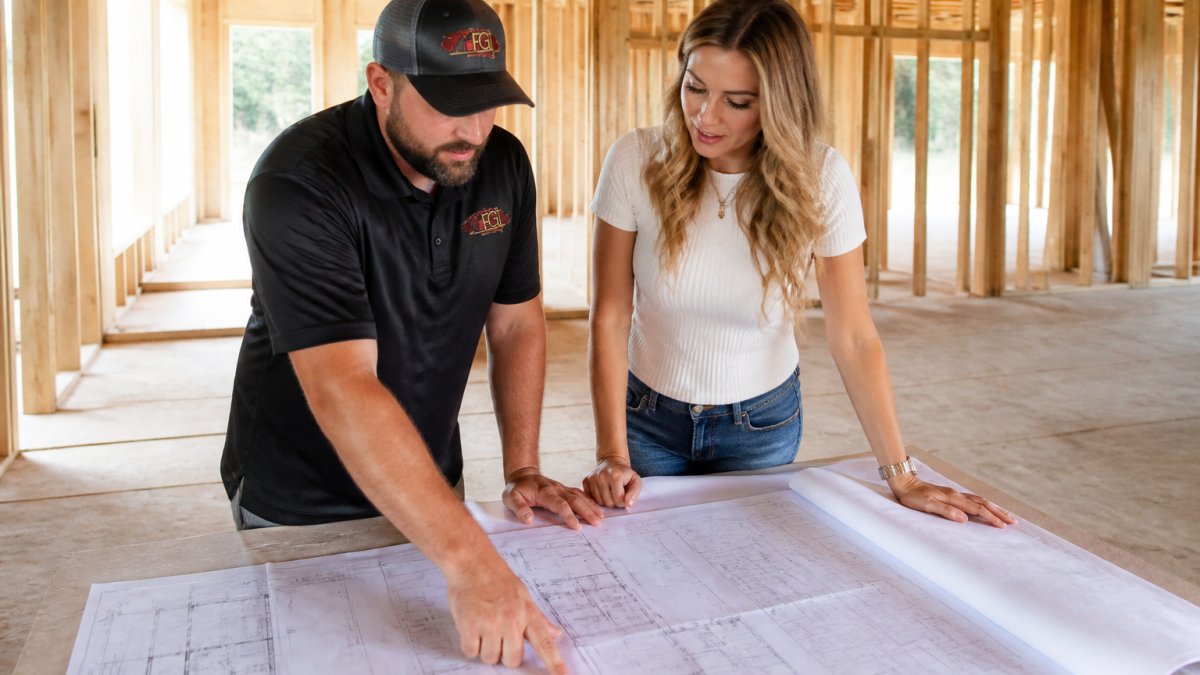
The custom home building process can include land evaluation, design, permitting, construction, and a final walkthrough. The duration of each stage depends on the project.
Stage 1: Land Evaluation
Before design begins, consider what the lot can support. A buildable lot is not just a parcel with a legal address. Site considerations can include utilities, topography and drainage, setbacks and easements, soil conditions, and access.
If you already own land, this evaluation tells you what your lot will and will not accommodate. If you do not, it is how a lot gets screened before you commit. Our guide on building a custom home on land you own covers site considerations and what to prepare.
Stage 2: Design and Selections
Design moves from concept to construction documents. Finish selections are part of planning a custom home.
An allowance is a placeholder amount in a contract for an item not yet chosen. Ask your builder how allowances are handled.
Stage 3: Permitting and Municipal Review
Permitting requirements and review times vary by jurisdiction. Confirm the applicable requirements with the relevant local authority.
Ask your builder who prepares the submittal and who responds to reviewer comments.
Stage 4: Construction
Construction can include foundation, framing, rough-in, insulation and drywall, and finishes and trim. A pre-drywall walkthrough takes place after rough-in but before drywall, when framing and mechanicals are still visible. Photographing this stage can help you keep a record of the work before it is covered.
Stage 5: Final Walkthrough and Handover
At the final walkthrough, you and the builder can review the home together and document any items that need attention. Ask what documents are provided at handover.
At FGI Homes, one team handles each home from first sketch to final walkthrough. For a step-by-step view, see the FGI Homes building process.
What Drives Cost in New Construction Homes
Cost depends on the specific project. Understanding the factors involved can help you know what questions to ask.
Land and Site Work
Land and site conditions can affect project costs. Site work may include clearing, grading, drainage, and utility connections.
Square Footage, Layout, and Finish Level
Square footage, layout, and finish selections can affect project costs.
Total Cost of Ownership Beyond the Purchase
The purchase figure is not the whole cost. A complete view may include property taxes, HOA dues and assessments, homeowners insurance, utilities, and maintenance. For tax and lending questions, confirm details with your attorney or lender.
Financing and Incentives: What to Ask Before You Reserve
Financing options and requirements vary. Confirm financing details with your lender and attorney.
How Long Does It Take to Build a Custom Home?
A custom home typically takes longer than a production build, and the honest answer is that it depends on design complexity, permitting timelines, weather, and material availability. Anyone who quotes a firm date before design is complete is guessing.
The stages that most often extend a schedule are permitting and design revisions. Municipal review times vary by jurisdiction, and change orders made mid-build add time as well as cost. A builder who says so up front is easier to work with than one who promises a date and renegotiates later.
Questions to Ask a Home Builder Before You Sign
Ask about the contract, the change-order process, the warranty, and who your point of contact will be after closing.
- Who is my single point of contact from contract to closing?
- How are change orders priced and approved?
- What exactly does the warranty cover, and for how long?
- Which inspections happen, and at which stages?
- What is included in the base contract versus listed as an upgrade?
- How many homes are you building at the same time?
- Can I visit an active job site?
FGI Homes limits the number of builds at any given time.
Your New Construction Home Checklist
Work through this new construction home checklist before and during the build. It is a working document, not a formality.
- Confirm the lot is buildable
- Get the full contract in writing, including the scope and exclusions
- Review the warranty terms in detail before signing
- Attend the final walkthrough and document any items that need attention
Comparing Builders, Communities, and Home Specifications
Compare contract terms, change-order handling, warranty coverage, and supervision practices.
| What to Compare | What to Look For | Why It Matters |
|---|---|---|
| Contract clarity | Written scope, exclusions, allowances | Prevents surprise costs later |
| Change orders | Fixed pricing process, written approval | Protects your budget mid-build |
| Warranty | 1-2-10 coverage explained in writing | Defines your protection after closing |
| Supervision | Homes under construction at once | Affects attention per project |
| Inspections | Named stages and third-party checks | Catches issues before they are hidden |
| Communication | One named contact | Reduces handoff errors |
FGI Homes backs its work with a 1-2-10 builder warranty: one year on workmanship and materials, two years on mechanical systems, and ten years on structural components. For a broader evaluation framework, see our guide to comparing custom home builders in DFW.
Applying for a Private Consultation
The next step is a conversation about your land, your plans, and your timeline. FGI Homes is a woman-owned builder serving Kaufman, Dallas, Tarrant, Collin, Denton, Rockwall, Ellis, Johnson, Parker, and Hood counties. We handle custom builds and land-plus-home packages.
You can apply for a private consultation.
Frequently Asked Questions
What should I look for when buying a new build home?
Start with the lot and the site. Then review the floor plan against how you actually live, and ask which finishes are included. Ask for the warranty terms in writing. In the Dallas area, compare specifications rather than relying on listing photos alone.
What is the difference between a custom home and a move-in-ready new construction home?
A custom home is designed around your land and plans. FGI Homes builds custom homes on a client's land or on land it helps them find. A move-in-ready home is already finished or nearly finished. The right option depends on the buyer's circumstances.
How long does it take to build a custom home?
It depends on the size of the home, the condition of the lot, permitting in the local jurisdiction, weather, and other project details. Ask your builder how the schedule and changes are handled, and confirm relevant terms before you sign.
Can I build a custom home on land I already own?
Yes. FGI Homes builds custom homes on a client's land. Confirm with your attorney and lender how the land is titled and financed before construction begins.
Building a custom home in the DFW area involves real decisions about land, cost, and process, and the right builder makes those decisions easier to see clearly. FGI Homes brings one team from first sketch to final walkthrough, limits the number of builds at a time, and explains cost drivers before you commit. Get started with FGI Homes and apply for a private consultation to review your project.
