

Last Updated: October 26, 2026
Quick Summary
A custom home land plus home package bundles the lot purchase and the house built on it into one continuous project, with the builder reviewing the land, designing a floor plan around it, managing site work, and handing over a finished custom home. At FGI Homes, we run these packages as a single project rather than two disconnected transactions, because most expensive surprises happen in the gap between buying dirt and pouring concrete.
- The National Association of Home Builders reported 36,000 custom-building starts in the first quarter of 2026.
- A buildable lot has legal access, usable drainage, and room to place a home within setback and utility easement lines.
- Land due diligence typically includes title review, survey, soil testing, flood zone checks, and confirmation of zoning and deed restrictions.
- Confirm utility availability and capacity in writing with each provider before you close on the land.
- Site preparation covers land clearing, grading, erosion control, and utility trenching between a raw lot and a foundation.
Table of Contents
- What a Custom Home Land Plus Home Package Includes
- What Makes a Lot Buildable in Texas
- Land Due Diligence for Home Building
- Utilities for a New Home Build
- Site Preparation and the Construction Timeline
- Your Land and Home Package Checklist
- Apply for a Private Consultation
- Frequently Asked Questions
What a Custom Home Land Plus Home Package Includes
Custom home land plus home packages bundle two purchases that usually happen years apart: the lot and the house built on it. The builder reviews the land, designs a floor plan around it, manages site work, and hands over a finished custom home. The National Association of Home Builders reported 36,000 custom-building starts in the first quarter of 2026, according to Eye on Housing's custom home building analysis, so this is not a niche path.
At FGI Homes, we run these packages as one continuous project rather than two disconnected transactions, because most expensive surprises happen in the gap between buying dirt and pouring concrete.
Here is what a package typically covers:
- Land review and lot selection, including a buildability assessment before you commit
- Home design and floor plan customization
- Permits, zoning checks, and building code compliance
- Site preparation: clearing, grading, and foundation work
- Utility connections and access improvements
- Construction, finishes, and a final walkthrough
Custom Builds Compared With Pre-Designed Packages
A custom build gives you design control in exchange for more decisions and a longer process. You can browse completed custom builds to see what a finished package looks like. A pre-designed package trades flexibility for speed and predictability.
| Factor | Custom Build | Pre-Designed Package |
|---|---|---|
| Design control | Full, plan drawn for your lot | Limited to set plans |
| Decision load | High | Low |
| Timeline | Longer, depends on design and site work | Typically shorter |
| Site flexibility | Adapts to unusual lots | Best on straightforward lots |
| Change orders | Common during design | Rare |
Custom builds generally cost more and take longer than factory-built alternatives, though they deliver greater design control, as HomeNation's comparison of custom and manufactured homes notes.
What Makes a Lot Buildable in Texas
A buildable lot has legal access, usable drainage, and room to place a home within setback and utility easement lines. Texas adds its own wrinkles: expansive clay soils, floodplain mapping, and county-level rules that vary widely. A lot that looks perfect from the road can fail any one of these tests.
Access, Drainage, and Setbacks
Access means a legal, recorded route to the property, not a handshake with a neighbor. Drainage means water moves away from the homesite. Setbacks are the minimum distances a structure must sit from property lines, and easements may cut into the buildable area further.
Buying land before confirming legal access is the most common and most expensive mistake in this process. A landlocked parcel can be nearly impossible to build on regardless of how good the price looks.
Land Due Diligence for Home Building
Land due diligence for home building is the research stage where you verify what the lot can legally and physically support before money changes hands.
Our land and build resources walk through the checks we recommend before you commit to a lot. Bring in your attorney and lender early: we can tell you whether a lot is buildable, but your attorney can confirm the title is clean, and your lender can confirm the purchase and construction can be financed the way you want.
What Each Due Diligence Check Actually Reveals
Here is what the common checks surface, in plain language:
- Title commitment. A title company reviews the public record and reports who owns the land, what liens exist, and what recorded restrictions or easements run with it. A surprise lien or an heir who never signed off can stall a closing. Your attorney reads the commitment and tells you what to negotiate.
- Survey. A licensed surveyor maps the actual boundaries, improvements, and easements on the ground, catching fences built in the wrong place, encroachments from a neighbor's shed, and utility easements that cut through your intended homesite.
- Soil testing. A geotechnical engineer takes borings and reports what the soil is made of and how it behaves when wet. In this region, expansive clay soils shrink and swell with moisture, and the report tells your foundation designer what type of foundation and reinforcement the site likely needs. Skipping this step can lead to foundation issues later.
- Flood zone check. FEMA flood maps show whether the property sits in a Special Flood Hazard Area. A lot in a flood zone can still be buildable, but it usually means elevation requirements, higher insurance, and a different foundation approach. Your lender will also care.
- Zoning and deed restrictions. Zoning tells you what the local jurisdiction allows on the lot. Deed restrictions and HOA rules can be stricter, minimum square footage, setback rules, architectural review, even limits on construction type. A lot can be zoned for a house and still be restricted against the house you want.
- Utility availability. Confirming that water, power, and sewer or septic are actually available at the street, not just nearby, is covered in more detail in the utilities section below.
How Due Diligence Changes the Deal
Due diligence is not a pass/fail test; it is a negotiating tool. If the survey shows a utility easement through the best building spot, you can shift the homesite or renegotiate.
A practical due diligence list:
- Confirm legal access and recorded easements
- Order a survey and a title commitment
- Check flood zone status and drainage patterns
- Review zoning, deed restrictions, and HOA rules
- Test soil for foundation design
- Verify utility availability at the street
If any item comes back with a problem, get a professional opinion on what it means for your specific plan rather than assuming the worst or hoping it resolves itself.
Utilities for a New Home Build
Utilities for a new home build usually means water, electricity, sewer or septic, and sometimes gas and internet. Which ones are available, and how far they must travel to reach the house, drives a meaningful share of site cost. A lot inside a subdivision typically has utilities at the street; acreage often does not.
The variables that move cost most:
- Distance from the nearest utility tap
- Whether sewer is available or a septic system is required
- Whether a well is needed for water access
- Trenching, boring, and road-crossing requirements
What Each Utility Decision Actually Involves
Utility cost is not one line item but a series of separate decisions, each with its own provider, permit, and inspection.
Sewer or septic. A sewer connection is typically a tap fee plus a lateral line to the main.
Electricity. The local utility or electric cooperative provides service.
Gas. Natural gas may or may not be available.
Internet and communications. Fiber and cable availability varies widely by address.
Why Acreage Costs More to Connect
A subdivision lot is designed around utilities: the lines are already in the street, the easements are recorded, and the tap fees are known. An acreage lot is often the opposite. The nearest water main may be a quarter mile away, the power may require a new transformer, and the soil may or may not support a standard septic system.
How to Confirm Utilities Before You Commit
The practical sequence is:
- Identify each provider that serves the address, water, sewer, electric, gas, and internet.
- Ask each provider for a written availability statement and the tap or connection requirements.
- For septic, contact the local health authority about the site evaluation process and timeline.
- Share the results with your builder so the site plan and budget reflect what is actually available, and with your lender, since some loan programs have specific requirements for wells, septic, and utility connections.
None of this is legal, tax, or lending advice. Your attorney and lender should review the utility findings alongside your purchase contract and financing plan.
Site Preparation and the Construction Timeline
Site preparation covers everything between a raw lot and a foundation: land clearing, grading, erosion control, and utility trenching.
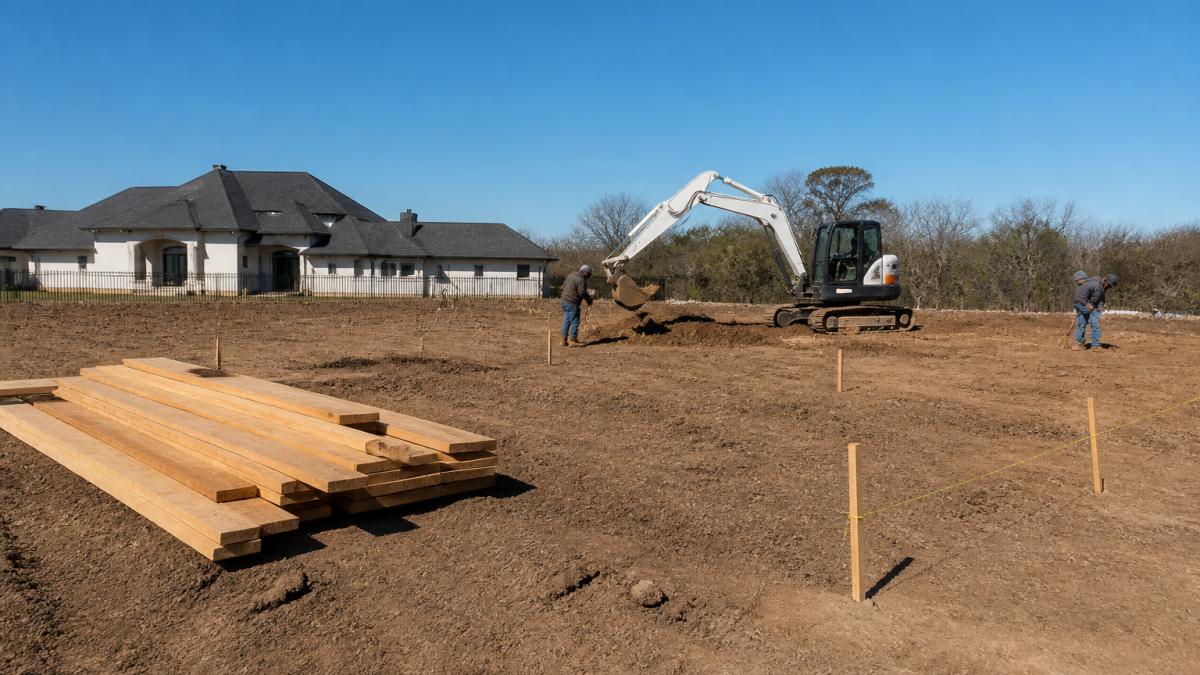
A typical sequence runs: design and permitting, site work, foundation, framing, mechanical rough-ins, finishes, and final inspection. Each phase depends on the one before it.
Our step-by-step build process shows how we sequence land review through final walkthrough on a single project.
Your Land and Home Package Checklist
A land and home package checklist keeps the two halves of the purchase from drifting apart. Use it to confirm the land is ready before design begins, and that the design fits the land before contracts are signed.
| Stage | What to Confirm | Why It Matters |
|---|---|---|
| Land search | Legal access, zoning, flood status | Rules out unbuildable lots early |
| Due diligence | Survey, soil test, title, easements | Prevents costly surprises |
| Utilities | Water, power, sewer or septic | Drives site cost |
| Design | Floor plan fits setbacks and terrain | Avoids redesign later |
| Permits | Local approvals secured | Keeps schedule realistic |
| Build | Site work, foundation, finishes | Delivers the finished home |
Apply for a Private Consultation
The gap between a lot that looks good and a lot that is ready to build is where most of the risk lives. Closing it takes a builder who reviews the land before the contract, not after.
FGI Homes is a woman-owned builder working across the DFW Metroplex.
Apply for a private consultation and we will review your land, your goals, and what a package would involve for your property.
Frequently Asked Questions
What is a land and home package?
A land and home package bundles the purchase of a buildable lot with the construction of a custom home on it. Instead of buying land separately and then hiring a builder, the package ties the property and the build together, often with a single closing and combined financing. It can include site work, utility connections, and the home itself. Ask the builder exactly what is included, because package contents vary. FGI Homes offers custom homes on your land or land they help you find, with one team handling the process from sketch to walkthrough.
Can you build a custom home on land you already own?
Yes. Many homeowners start with a piece of land and then hire a builder. The first step is confirming the lot is buildable: check zoning, setbacks, road access, water and sewer or septic feasibility, and drainage. A builder can walk the property with you and flag issues before you commit to a floor plan. FGI Homes builds custom homes on client-owned land across the DFW Metroplex and can review your lot during a private consultation.
What should you check before buying land for a custom home?
Start with land due diligence for home building: confirm zoning and permitted uses, verify legal access and road frontage, and check whether utilities are available or will need to be brought in. Test for septic feasibility if sewer is not present, review floodplain maps, and look at drainage and slope. Ask about easements, deed restrictions, and any HOA rules. A survey and a title check are standard. Confirm findings with your attorney and lender before you close.
How do utilities and site conditions affect a custom home build?
Utilities for a new home build often drive both cost and schedule. If water and sewer lines are not at the street, connection or well and septic work adds scope. Electrical service, gas, and internet may require coordination with providers. Site conditions matter too: clearing, grading, foundation design, and driveway access all depend on the lot. A buildable lot with utilities nearby is typically simpler than raw acreage. Have a builder assess the site before you finalize a budget.
