

Last Updated: November 1, 2026
Quick Summary
To get utilities to vacant land, confirm which providers serve the parcel and request written feasibility estimates for electric, water, and wastewater before your land contract is final. Verify legal access and recorded easements, since providers typically will not extend service without a legal route for their lines.
- Utility access means connecting a site to electric, water, and wastewater systems at reasonable distance and cost.
- Ask each provider for a written feasibility estimate rather than relying on a phone quote.
- A nearby power line does not guarantee capacity, so request a load and capacity review.
- A perc test tells you whether the soil can support a standard septic system.
- Record each provider's written scope and cost drivers on a worksheet to compare parcels fairly.
Table of Contents
- Start With Due Diligence on Utility Access
- How to Get Electricity to Vacant Land
- Water Options for Vacant Land
- Planning a Septic System for Vacant Land
- The Utility Connection Process for New Construction
- What Drives the Cost of Utilities to Vacant Land
- Apply for a Private Consultation Before You Buy the Land
- Frequently Asked Questions
Start With Due Diligence on Utility Access
Learning how to get utilities to vacant land starts before you sign a purchase contract.
Due diligence means answering four questions before you commit:
- Which utility company or electric cooperative serves this address?
- How far are the nearest power lines, water main, or sewer line?
- Does the parcel have legal access from a public road?
Many buyers fall in love with acreage first, then learn the nearest power line sits well beyond the boundary or a neighbor's land blocks the only practical route for a water line.
Our guide on building a custom home on land you own covers the full lot due diligence checklist.
Confirm Legal Access and Utility Easements
Legal access means the property touches a public road or has a recorded easement guaranteeing you can reach it.
An easement is a recorded right to use a strip of someone else's land for a specific purpose, such as running power or water lines. A right-of-way is similar: a corridor reserved for roads and utility infrastructure.
Ask the seller or title company for:
- The recorded legal description and plat
- Any existing utility easements on or near the parcel
- Road frontage details and maintenance agreements
If your only route to power crosses a neighboring property, you need a written, recorded easement, a verbal handshake is not enough. Confirm the details with your attorney before closing.
Ask Providers for Written Feasibility Estimates
Phone estimates are not commitments. Ask each provider for a written feasibility estimate stating whether service is available, what infrastructure exists nearby, and what work the connection would require.
How to Get Electricity to Vacant Land
Electricity usually comes down to two questions: which provider serves the address, and can that provider actually deliver the load your home will need? Answer both before you make an offer.
Step 1: Identify the Serving Provider
Start by identifying the electric provider. In many parts of Texas, that means an electric cooperative or municipal utility rather than a large investor-owned company.
Do not assume the provider serving the nearest town serves your parcel. Service territories follow their own boundaries, and land on the edge of one territory may be served by a different cooperative than the land across the road.
Step 2: Request a Capacity and Load Review
A power line running past the property does not guarantee the provider can serve your home. The line may be sized for a few rural meters, and your home's load, HVAC, well pump, electric vehicle charging, shop equipment, may exceed what the existing transformer and conductor can carry.
Ask the provider for a capacity review that confirms:
- The nearest available line and its voltage
- Whether the existing transformer has capacity for your expected load
- Whether an upgrade to the line or transformer would be required
This is the step most buyers skip. A nearby line is a starting point, not a commitment.
Step 3: Understand How Line Extensions Are Priced
Line extension is the work of building new power lines from the nearest existing line to your building site. The provider typically performs this work, and the cost depends on distance, terrain, and how many poles or transformers the run requires.
Provider extension terms vary, and the specific contribution requirements are set by each provider's tariff, the filed document governing how it serves customers, so ask for the tariff section covering extensions.
Step 4: Get the Engineering and Written Estimate
Phone estimates are not commitments. Ask for a written estimate stating the scope: distance, pole count, transformer size, easements the provider needs, and the terms of any owner contribution.
Watch out: clearing a path for power lines without checking the provider's requirements can mean rework. The provider sets the specifications for pole placement, clearance, and access, and its crews or approved contractors must meet them.
Step 5: Confirm Easements and Access for the Provider
The provider needs a legal route for its line. If the extension crosses a neighboring property, the provider will typically require a recorded easement from that owner before construction. If the route crosses your own land, the provider will record an easement on your parcel. Review both with your attorney before signing.
Off-Grid and Hybrid Alternatives
When a grid extension is impractical or the terrain makes it uneconomical, some owners consider alternatives. Some owners consider off-grid options such as solar with battery storage, a standby generator, or propane, which each carry different upfront commitments, maintenance needs, and backup requirements. Each option has trade-offs in maintenance, capacity, and resale, so compare them against the provider's written extension terms rather than against a phone quote.
A Note on Timing
Utility work runs on the provider's schedule. Extension design, easement recording, and construction can take time, and the sequence depends on the provider's workload and the parcel's complexity. Start the provider conversation as early as possible, ideally before the land contract is final, so utility work can be sequenced with site preparation and permitting.
Water Options for Vacant Land
Water is where rural property diverges fastest. Some parcels can connect to a municipal water system.
A municipal water connection ties the home to a public water supply.
A private well draws groundwater on the property. Drilling involves permitting, locating a viable water-bearing zone, and testing water quality.
Compare the two honestly:
- Municipal water usually means a connection fee and meter installation, plus monthly service.
- A well usually means drilling, a pump, pressure tank, and water treatment, plus testing and maintenance.
Water availability also affects your lender and your builder's site plan.
Planning a Septic System for Vacant Land
If no municipal sewer line reaches the parcel, you will likely need a septic system. A septic system treats household wastewater on site, and its design depends on the soil.
A septic system for vacant land must be designed for that specific site. Soil type, depth to groundwater, slope, and setback distances from wells and property lines all shape the design.
Plan for these steps:
- Hire a licensed designer to evaluate the soil and propose a system
- Confirm local permitting requirements with the county
- Reserve space on the site plan for the drain field
A common mistake is buying a parcel before the soil evaluation.
The Utility Connection Process for New Construction
Once the land is under contract, utility coordination becomes a sequence. Here is how a build typically moves from due diligence to activation.
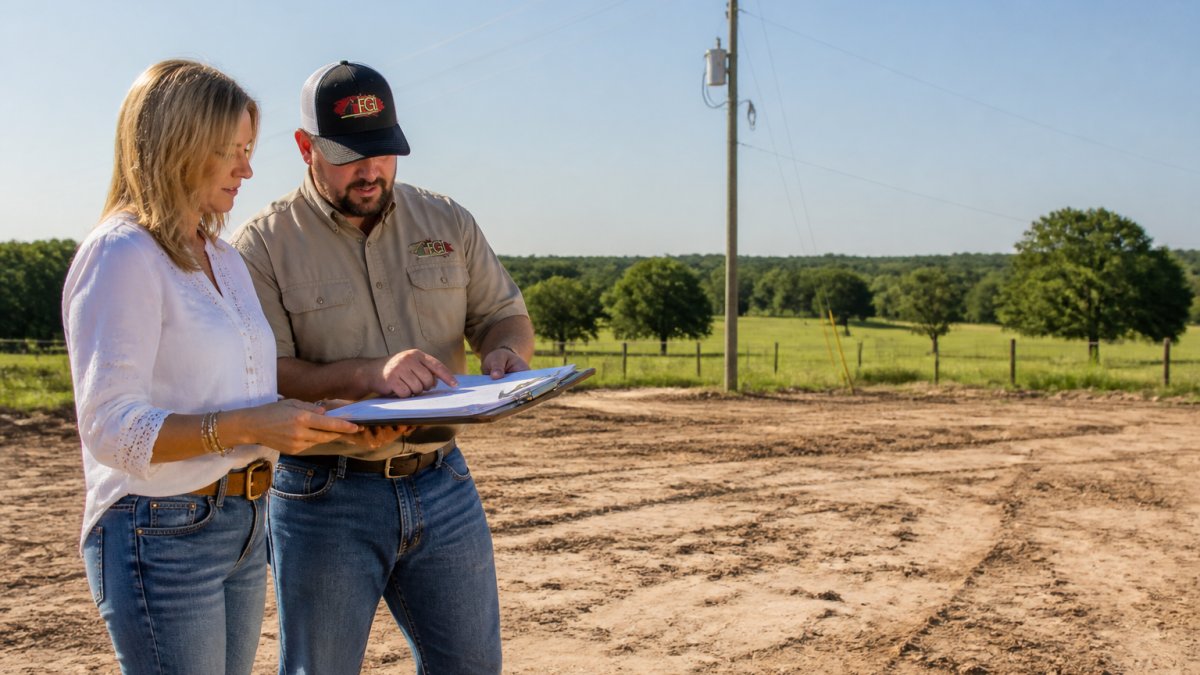
- Confirm providers and written estimates. Collect feasibility letters from electric, water, and wastewater providers.
- Finalize the site plan. Place the home, driveway, well or water tap, septic system, and utility runs on one drawing.
- Submit permit applications. County and provider permits often run on separate tracks, so start early.
- Complete site preparation. Clear and grade the building pad and utility corridors before crews arrive.
- Install service connections. The provider or its contractor runs lines, sets meters, and inspects the work.
- Schedule inspections and activation. Each provider signs off before service turns on.
Our build process describes how construction is planned from start to finish.
What Drives the Cost of Utilities to Vacant Land
Utility costs vary widely from parcel to parcel, and pricing depends on the specifics of each site. What we can do is explain the cost drivers and show you how to build a comparable estimate for each parcel you consider. For more on budgeting and land costs, see our guides to building a custom home in North Texas.
Build a Utility Cost Worksheet for Each Parcel
The most useful tool is a simple worksheet with one column per parcel and one row per utility. For each row, record the provider's written scope, the work required, and the cost driver. This lets you compare parcels on the same basis instead of a phone quote on one against a guess on another.
| Utility | What to Record | Primary Cost Drivers |
|---|---|---|
| Electric | Provider name, nearest line distance, transformer size, extension tier, easement needs | Distance, pole count, transformer upgrades, terrain, provider tariff terms |
| Water | Municipal availability letter or well plan, meter size, tap location | Distance to main, main capacity, connection fees, well depth and yield, treatment needs |
| Wastewater | Sewer availability or septic design, soil evaluation results | Distance to sewer, lift station needs, soil type, system size, drain field area |
| Fuel | Natural gas availability or propane plan | Distance to gas main, tank size and placement, supplier terms |
| Permits | County and provider permit list | Review fees, inspection requirements, review timelines |
Electric Cost Drivers in Detail
- Distance to existing infrastructure. Longer runs of power generally cost more because they require more poles, conductor, and labor.
- Transformer and capacity upgrades. If the existing transformer cannot carry your load, the provider may require an upgrade, and the cost allocation depends on the provider's tariff.
- Terrain and access. Rock, slope, wetlands, and limited access affect trenching, pole setting, and crew time.
Water Cost Drivers in Detail
- Municipal connection. The water authority's connection fee, meter size, and the distance from the main to the building site all shape the cost. A main across the road is a different project from a main a quarter mile away.
- Private well. Well depth, the depth to a viable water-bearing zone, pump and pressure tank sizing, and water treatment all drive cost. Water quality testing may reveal the need for filtration or softening.
- Capacity. The water authority may lack capacity to add a connection even if a main is nearby, which can push the project toward a well.
Wastewater Cost Drivers in Detail
- Sewer connection. Distance to the sewer main, the need for a lift station if the site is lower than the main, and the authority's connection fees all matter.
- Septic system. Soil type, depth to groundwater, slope, and setback distances shape the design. A site that supports a conventional system is a different project from one that needs an alternative design.
- Permitting. County health department review and inspection requirements add steps and cost.
Fuel Cost Drivers in Detail
- Natural gas. Availability depends on whether a gas main runs near the property. Extension terms are set by the gas utility.
- Propane. A tank, placement, and supplier delivery terms replace a gas main connection. Propane is common where natural gas is not available.
Site Work That Overlaps With Utility Work
Clearing, grading, and access roads often go hand in hand with utility installation. Trenching for water and power, setting poles, and bringing in equipment all require access, and doing site work and utility work in the same phase can reduce duplication. Coordinate the site plan so utility corridors and the building pad are cleared together.
How to Compare Parcels Fairly
Ask each provider for a written estimate with the same scope: distance, work required, owner contribution, and any conditions. Then compare the worksheets side by side. A parcel with a higher headline extension cost may still be the better choice if it avoids a well, a lift station, or a long easement negotiation. A parcel with a nearby line may carry hidden capacity upgrade costs.
Apply for a Private Consultation Before You Buy the Land
Finding utility questions before closing is far easier than solving them afterward. That is why buyers are encouraged to bring a parcel to us early, before the contract is final.
One team stays with your home from first sketch to final walkthrough, and we take on a limited number of builds at a time.
You can apply for a private consultation with our team, or contact us to ask questions and schedule a showing.
Frequently Asked Questions
What utilities do you need before building on vacant land?
Most homes need electricity, water, and wastewater handled before construction starts. Electricity comes from the local electric provider or cooperative. Water comes from a municipal connection or a private well. Wastewater goes to a municipal sewer line or a permitted septic system. Propane is often added for heating, cooking, or backup power where natural gas is not available. Confirm each one in writing before you close on the land.
How do you find out which utilities are available at a vacant lot?
Start with the county and the local utility providers. Call the electric provider or cooperative that serves the address, the water utility or county environmental office, and the county permitting department. Ask whether lines are nearby, what capacity exists, and what a connection would involve. Request written estimates rather than verbal answers, since the numbers decide whether the lot works for your build.
How long does it typically take to connect utilities to land?
Timing depends on the utility, the distance to existing lines, permitting, and whether the work needs easements or road crossings. A straightforward service connection can move faster than a long line extension or a new well and septic install. Ask each provider for a written schedule and build slack into your plan. Your builder can help sequence utility work so it does not hold up the foundation.
What should you ask utility providers before buying vacant land?
Ask whether the property is inside their service area, how far the nearest lines are, whether capacity exists, and what easements or rights-of-way are needed. Ask who pays for the line extension and how the connection fee is calculated. Ask for a written estimate and expected timeline. Get the same answers for water and wastewater, then review everything with your attorney before you sign.
Utility access is the detail that quietly decides whether a land purchase works. If you are weighing a parcel and want a builder's eyes on it before you commit, apply for a private consultation with FGI Homes. We will walk the land with you, review utility feasibility, and help you plan a home that fits the site, backed by our 1-2-10 builder warranty and one-on-one collaboration from start to finish.
