
Last Updated: October 30, 2026
Quick Summary
Small scale custom builders take on a limited number of homes at once, which means one team carries each home from first sketch to final walkthrough and decisions get made with more direct access to the people building your house. The model trades volume for attention, so you get site-specific design and clearer communication, but start dates and subcontractor availability depend on the builder's capacity.
- A production builder repeats set floor plans at volume, while a custom builder designs around your land and priorities.
- The most common source of delay is a decision made late, not a trade crew running behind.
- Ask each builder how many homes they are building now and how many they can take on at once.
- Allowances are placeholder amounts in the contract, and selections above them become change orders.
- FGI Homes carries a 1-2-10 builder warranty covering workmanship, mechanical systems, and structural.
Table of Contents
- Why Small Scale Custom Builders Change the Building Experience
- Custom Home Builder vs Production Builder: Where the Difference Shows Up
- The Custom Home Building Process With a Small Team
- What a Custom Home Construction Timeline Actually Depends On
- Questions to Ask a Custom Home Builder Before You Sign
- The Trade-Offs of Hiring a Small Scale Custom Builder
- Apply for a Private Consultation With FGI Homes
- Frequently Asked Questions
Why Small Scale Custom Builders Change the Building Experience
The difference shows up fastest in the small moments. On a large production site, your superintendent may be juggling dozens of homes and rotating trade crews.
Here is what we cover below: how the small-builder model differs from production building, what the process actually looks like, what drives your timeline, the questions worth asking before you sign, and the honest trade-offs.
Custom Home Builder vs Production Builder: Where the Difference Shows Up
A production builder sells a set of floor plans and builds them repeatedly at volume, while a custom home builder designs around your land, your priorities, and your selections.
Production building works because repetition is efficient. Custom building is designed around your plan and selections, while the builder's capacity limits how many homes move at once.
If you are still weighing models, our guide to comparing custom home builders in DFW walks through contracts, timelines, and warranty terms side by side so you can evaluate any builder on the same criteria.
How Each Model Handles Decisions and Changes
In a production build, selection choices are usually limited to a catalog, and change orders after contract signing can trigger fees and schedule reshuffling. In a custom build, decisions happen earlier and with more input, but they still need to be documented in writing.
A common mistake buyers make is assuming "custom" means unlimited changes at any time. It does not. What changes is who you talk to and how quickly a decision gets priced and scheduled.
The Custom Home Building Process With a Small Team
The custom home building process runs through a predictable sequence: site evaluation, design and budgeting, permitting, construction, and final walkthrough. What differs with a small team is who is present at each stage.
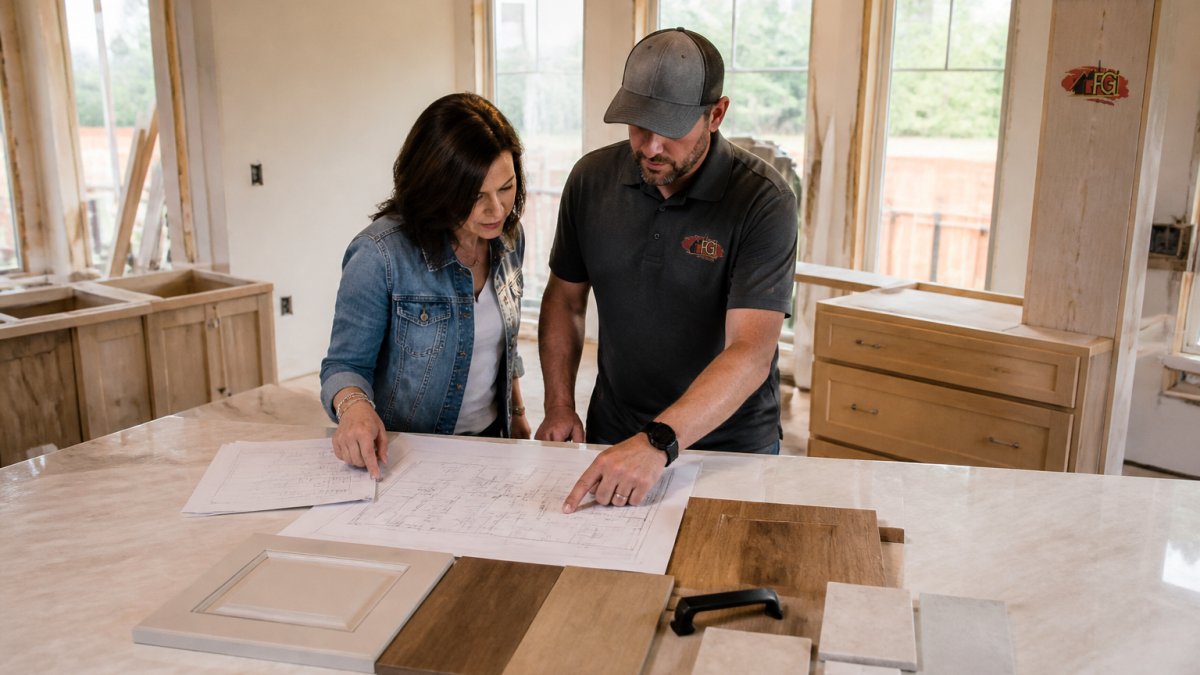
A custom build typically follows this sequence:
- Site and feasibility review - what the land allows, including utilities and access
- Design and plan development - floor plan, elevation, and finish direction
- Budget alignment - scope matched to priorities before contracts
- Permitting and approvals - local requirements and inspections
- Construction - site management, subcontractor scheduling, and progress updates
- Final walkthrough and warranty handoff - punch list, then your 1-2-10 builder warranty
You can review the custom home building process on our process page.
What the Builder Handles and What Stays With You
The builder typically carries permits, subcontractor coordination, site management, and schedule tracking. You carry the decisions: layout priorities, finishes, and how you want the home to function day to day.
Watch out: the most common source of delay is a decision made late, not a trade crew running behind.
A custom build typically follows this sequence, with the builder carrying coordination and you carrying the decisions.
| Step | What happens | Who carries it |
|---|---|---|
| Site and feasibility review | What the land allows, including utilities and access | Builder |
| Design and plan development | Floor plan, elevation, and finish direction | Shared |
| Budget alignment | Scope matched to priorities before contracts | Shared |
| Permitting and approvals | Local requirements and inspections | Builder |
| Construction | Site management, subcontractor scheduling, progress updates | Builder |
| Final walkthrough and warranty handoff | Punch list, then 1-2-10 builder warranty | Builder |
| Layout, finishes, daily function | Decisions on how the home works day to day | You |
What a Custom Home Construction Timeline Actually Depends On
There is no standard custom home construction timeline. Duration depends on design complexity, permitting speed in your jurisdiction, material lead times, weather, and how quickly selections are finalized.
Two homes of similar size can run very different schedules for reasons that have nothing to do with the builder's effort. A complicated roofline, a difficult site, or a specialty finish with a long lead time all add weeks. So does a change order that lands mid-framing.
What a small builder can offer is a clearer view of the schedule when something needs attention.
If you already own land, our guide to building a custom home on land you own covers the site questions that affect scheduling before design even starts.
Questions to Ask a Custom Home Builder Before You Sign
Most guides hand you a list of questions and stop there. The useful part is knowing what a strong answer sounds like, what a vague answer signals, and how to verify the claims before you sign anything. Use this as a working script in your interviews, not a box to tick.
Capacity, workload, and schedule risk
- "How many homes are you building right now, and how many can you take on at once?" A small builder should be able to name an active count and a cap. If the number sounds like more than the team can supervise, ask who else is on site day to day.
- "What happens to my schedule if a prior build runs long?" Listen for a real answer about how start dates are sequenced. A builder who says it never happens is guessing.
- "Which parts of my timeline depend on permits, and which depend on you?" Permitting speed varies by jurisdiction, and material lead times vary by product. A builder who separates those from their own work is being honest about what they control.
Communication and accountability
- "Who is my single point of contact, and how often will I hear from them?" The best answer names a person and a cadence, for example, a weekly written update plus scheduled site meetings.
- "How are decisions documented?" Look for written change orders, signed selections, and a running decision log. Verbal approvals are where disputes start.
- "Who tells me when something slips, and how soon?" A builder with a process will describe when and how they flag a delay, not just that they will.
Money mechanics: allowances, change orders, and contingencies
This is where custom building most often surprises first-time buyers, so ask directly:
- "Which line items are allowances, and what happens if my selections come in above them?" An allowance is a placeholder amount in the contract for something not yet chosen, like tile or lighting. If your pick costs more, the difference is a change order. Ask how allowances are set and how overages are handled.
- "How are change orders priced and approved?" You want a written process: who prices it, how long it takes, and whether work pauses until you sign.
- "Is there a contingency, and what is it for?" A contingency is a reserved buffer for unknowns like site conditions. Ask what it covers and how unused amounts are handled at close.
Licensing, insurance, and contracts
- "Can you show your state license and current insurance certificates?" Ask for general liability and workers' compensation coverage, and confirm the certificates are current.
- "Who is the contracting party, and what does the contract say about scope, schedule, payment schedule, and dispute resolution?" Read it before signing, and have your attorney review it. We do not give legal advice, so confirm contract terms with your own attorney.
- "How are payments tied to progress?" A draw schedule tied to completed milestones is a common pattern; ask how it works.
Evidence of performance and aftercare
- "Can I see finished homes and speak with past clients?" Ask for references from builds completed in the last year or two, and ask those clients how the builder handled a problem, not just whether they liked the house.
- "What does your warranty cover, and how do I file a claim?" Ask for the warranty in writing and how defect calls are handled after close. Our own warranty is a 1-2-10 builder warranty: one year on workmanship and materials, two years on mechanical systems, and ten years on structural.
- "What does aftercare look like in the first year?" A builder with a process will describe how punch-list items and warranty calls are tracked.
If you are comparing several builders on the same criteria, our guide to comparing custom home builders in DFW lays out contracts, timelines, and warranty terms side by side.
The Trade-Offs of Hiring a Small Scale Custom Builder
Small scale custom builders trade volume for attention, and that trade has real costs worth naming plainly. The model has specific advantages and specific risks, and both depend on how the builder runs their operation.
Where the small-builder model helps
- Access to decision-makers. With fewer homes in progress, communication can be more direct. Fewer layers can mean fewer handoffs where details get lost.
- Flexibility earlier in the process. A small team can typically absorb design changes more easily before contracts and permits lock in scope. After that, change orders still apply, custom does not mean unlimited changes.
- Direct discussion of craftsmanship, materials, and finishes. Selections get talked through with the people making the decisions, which tends to surface trade-offs between durability, maintenance, and look.
Where the small-builder model carries risk
- Capacity and start dates. A limited number of active builds means your start may depend on when a slot opens. Ask how start dates are sequenced and what happens if a prior build runs long.
- Subcontractor availability. Small builders typically rely on trade crews they do not always employ directly. Ask how the builder manages trade availability and what happens when a crew is late.
- Continuity risk. A small team has fewer people to absorb a sudden absence. Ask who covers if a key person is unavailable and how knowledge about your build is documented.
How to tell a well-run small builder from a busy one
"Small" is not automatically better. A small builder without a clear process is just a busier version of the same problems. Look for evidence:
- A named point of contact and a stated communication cadence
- Written change-order and allowance processes
- A documented schedule with the variables they control separated from the ones they do not
You can view our move-in ready home in Forney on our showing request page.
Apply for a Private Consultation With FGI Homes
Choosing a builder comes down to fit: capacity, communication, and whether the process makes sense to you. If you are planning a custom home on your land, or looking at new construction in the area, a conversation is the fastest way to find out whether we are the right team.
FGI Homes is a woman-owned builder serving Kaufman, Dallas, Tarrant, Collin, Denton, Rockwall, Ellis, Johnson, Parker, and Hood counties. You can apply for a private consultation and we will walk through your land, your priorities, and what the process would look like.
Frequently Asked Questions
What are the benefits of working with a small scale custom builder?
The main benefits come down to attention and control. A small scale custom builder typically takes on fewer homes at once, which can mean more direct communication. That can also mean more say over materials and finishes, and a floor plan drawn around how you actually live. The trade-off is capacity: fewer slots means less scheduling flexibility, so ask about current workload early.
How is a small custom builder different from a production builder?
A production builder repeats a set of floor plans across many lots and buys materials in bulk, which is why the process feels standardized. A custom builder starts from your land and your priorities, so design is built around your plan. The custom home builder vs production builder comparison usually comes down to this: production wins on speed and predictability of a known plan, small custom wins on originality and control. Neither is automatically better. Match the model to how much you want to customize.
What should I ask a custom home builder before signing a contract?
Ask how many homes they are building right now and who supervises your job day to day. Request the change order process in writing, including how costs are presented before work proceeds. Ask which subcontractors they use regularly and how long they have worked with them. Confirm what the warranty covers and for how long. Ask for references from the past two years and call them. Finally, ask what happens if the schedule slips and who communicates that to you. Vague answers on any of these are worth noting.
How long does it typically take to build a custom home?
A custom home construction timeline depends on the size and complexity of the design, site conditions, permitting in your county or city, material lead times, and the builder's current workload. Material costs and lead times can shift over time. A builder who takes on a limited number of builds at a time can often give you a more specific schedule because your home is not competing with dozens of others for the same crew.
