
Last Updated: November 2, 2026
Quick Summary
To verify builder craftsmanship, check the builder's licensing and complaint history, visit at least two finished homes to confirm quality holds steady, and inspect each stage before it is covered up. Ask who inspects the work and get every defect and material substitution in writing.
- Visit two finished homes, not one, to judge whether quality holds steady.
- Pre-drywall is the highest-value walk because drywall conceals everything behind it.
- Compare delivered materials against the specification sheet for brands, models, and grades.
- Record each defect with a dated photo, location, and description, then set a reinspection date.
- Escalate safety or structural issues in writing immediately and ask for the repair method.
Table of Contents
- Start With the Builder's Reputation and Track Record
- How to Inspect Past Projects for Consistency of Work
- Questions to Ask Custom Home Builders About Quality Standards
- Your New Construction Inspection Checklist, Stage by Stage
- Verify Materials Against the Specification Sheet
- Judge Finishes, Fixtures, and Alignment Like an Inspector
- Document Defects and Know When to Escalate
- Apply for a Private Consultation With FGI Homes
- Frequently Asked Questions
Start With the Builder's Reputation and Track Record
Verifying builder craftsmanship starts before you ever walk a framed wall. It starts with the paper trail.
Check these sources first:
- State licensing and complaint history through your state's licensing board
- Permit and inspection records through the local building department
- Client references from homes finished at least two years ago
- Online reviews read for patterns, not single complaints
The NAHB Residential Construction Performance Guidelines give you a shared vocabulary for what "acceptable workmanship" means. Ask whether a builder works to a published standard.
At FGI Homes, we limit how many builds we take on at once. For a broader comparison framework, see our guide to the best custom home builders in DFW.
How to Inspect Past Projects for Consistency of Work
Ask to visit two finished homes, not one. One home shows you a best case. Two homes show you whether the quality holds steady.
Walk each home with a simple eye. Look at the same details in every room:
- Trim joints: tight, or gapping?
- Cabinet doors: flush, or rubbing?
- Floor transitions: level, or catching a toe?
- Paint edges: crisp, or wavy?
- Caulk lines: smooth, or smeared?
Consistency of work across separate projects is the real signal. Anyone can nail one house. Repeating it takes systems.
You can also see FGI Homes' finished work, including 1012 Devonshire in Forney, available now, plus past and upcoming builds. Seeing completed homes in person lets you judge workmanship consistency yourself.
Questions to Ask Custom Home Builders About Quality Standards
The right questions separate builders with a quality system from builders with a quality slogan. Ask these before you sign:
- Who inspects the work at each stage, and what do they check?
- Do you use third-party inspectors beyond the required municipal inspections?
- How do you document defects, and who signs off on the fix?
- What happens if a material is unavailable? Who approves a substitution?
- How do you handle change orders, and when do I see the cost?
- What does your warranty cover, year by year?
Listen for specifics. A builder who answers with named stages and named people has a process. A builder who answers with "we build quality homes" does not.
Our building process page shows how quality checks are built into each stage, so you can compare answers side by side. And ask about the warranty in plain terms. Ours is a 1-2-10 builder warranty: one year on workmanship and materials, two years on mechanical systems, and ten years on structural.
Your New Construction Inspection Checklist, Stage by Stage
A new construction inspection checklist works best when it matches the stage of the build. Each phase reveals things the next phase hides. Once drywall goes up, you cannot check framing. Once concrete pours, you cannot check the base.
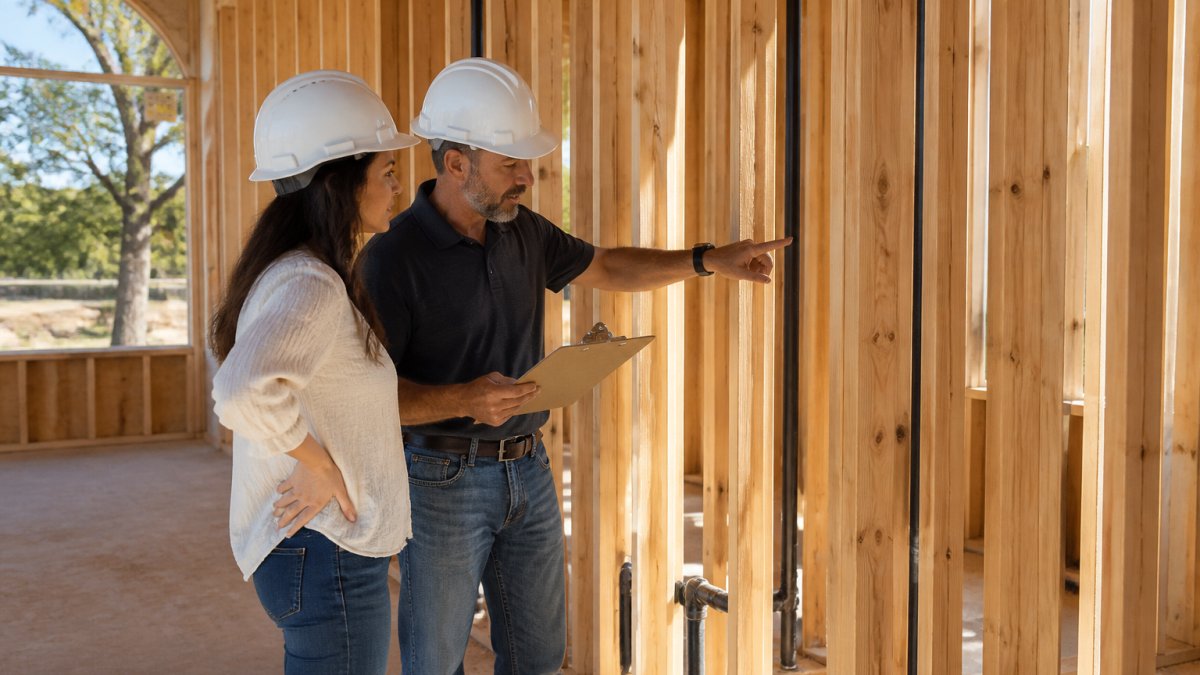
Bring the same three things to every walk: the approved plans, the specification sheet, and a dated notebook or phone camera. Ask the builder's superintendent to walk with you, and ask who signs off on each stage. If an independent inspector is part of your plan, schedule them before the stage closes, not after.
Foundation and pre-pour
This is the last chance to see what will be buried. Check that forms follow the plan, reinforcement is in place and tied, and plumbing and conduit sleeves are located where the drawings show them.
Watch out: a slab poured before the pre-pour inspection is signed off can hide misplaced plumbing or missing reinforcement that will surface as cracks or slow drains later.
Framing
Framing is where square, plumb, and level get set for everything that follows. Walk the rooms and check that studs are straight and spaced per plan, headers and beams match the drawings, and window and door openings are square. Look for cracked or bowed lumber and for trimmers that were cut short. Confirm the framing inspection record with the local building department before the next phase begins.
Pre-drywall (rough-ins and insulation)
This is the highest-value walk in the whole build, because drywall conceals everything behind it. Check that electrical boxes, plumbing lines, and HVAC ducts are roughed in where the plans show them, that insulation is installed to the specified R-value without gaps or compression, and that moisture barriers are lapped and sealed at penetrations.
Watch out: insulation that is compressed into a cavity or left with gaps at the edges performs below its labeled R-value, and you will not see it once the drywall is hung.
Final walkthrough
At the final walk, test function, not just appearance. Turn on every outlet, switch, and fixture. Open and latch every door and window. Check that floors are level, cabinets sit flush, and trim joints are tight. Run water at every fixture and watch for slow drains. Note anything that does not work as intended, and put it on the written punch list rather than mentioning it verbally.
What to do when an item fails
A checklist only helps if a failed item produces an action. For each item that does not pass, record the location, a dated photo, and a short description, then send it to the builder in writing. Ask for the repair method and a reinspection date. Keep the item open until you have seen the fix and confirmed it in writing. The U.S.
Verify Materials Against the Specification Sheet
Material quality is where substitutions quietly happen. Your contract should include a specification sheet listing brands, models, and grades. Bring it to the site and compare.
Check the labels on delivered materials:
- Lumber grade stamps on framing
- Insulation R-value printed on the batt
- Window and door model numbers on the frame
- Fixture and hardware part numbers on the box
If something does not match, ask before it is installed. A substitution made without your written approval is a contract issue, not a small detail. Get every change in writing, with the model number and the cost difference.
Judge Finishes, Fixtures, and Alignment Like an Inspector
Finishes are the easiest thing to see and the hardest thing to fake. Run your hand along surfaces. Open every drawer. Turn on every light.
Use this quick test list:
- Paint coverage: look for thin spots under raking light
- Trim and seams: joints should meet tight and even
- Level floors: a marble should not roll on its own
- Flush cabinets: doors should sit even with soft-close hardware working smoothly
- Alignment: outlet covers, switch plates, and tile grout lines should line up
One caution: not every imperfection is a defect. Industry standards and tolerances allow minor variations in finish lines and surfaces.
A private showing of a finished home lets you inspect finishes and alignment in person. You can schedule a showing at 1012 Devonshire to see the details up close.
Document Defects and Know When to Escalate
Documentation turns a complaint into a fix. Most builders respond to a written, dated, located record far faster than to a verbal mention at a walk. Build one running list per home, and treat it as a living document from the first walk through the warranty period.
Build the record
For every defect, capture four things: a dated photo, the room or location, a one-line description of what is wrong, and what you expected instead. Keep the photos in one folder sorted by date. A short video helps for anything that moves, such as a door that rubs or a drain that gurgles. Send the list to the builder in writing after each walk so there is a shared record of what was raised and when.
Sort each item into one of three buckets
| Defect type | Example | Action |
|---|---|---|
| Cosmetic | Paint thin spot, minor caulk line | Add to punch list, fix before closing |
| Functional | Door rubs, outlet dead, cabinet misaligned | Fix before closing, confirm in writing |
| Safety or structural | Cracked beam, water intrusion, bad grading | Stop and escalate immediately |
Put a deadline and a reinspection on each item
A punch list without dates drifts. For each item, ask the builder to confirm in writing what will be done and by when, then schedule a reinspection.
Watch out: a verbal promise to "take care of it after closing" is easy to lose. Get the commitment in writing with a date, or keep the item on the pre-closing punch list.
Escalate safety and structural issues immediately
Escalate safety or structural issues right away, in writing, and ask for the repair method before work continues. Examples include a cracked or undersized beam, water intrusion, or grading that sends water toward the foundation. Ask the builder to describe the repair in writing and, where the issue touches structural or building-code questions, confirm the approach with the local building department's inspection record. For anything with legal weight, confirm with your attorney.
Carry the record into the warranty period
Your documentation does not end at closing. Keep the same dated list and photos, and use them when you submit a warranty claim. Note the date you report each issue and the date it is resolved. Our warranty is a 1-2-10 builder warranty: one year on workmanship and materials, two years on mechanical systems, and ten years on structural. Knowing which year covers which item helps you report an issue to the right place and keep the paper trail intact.
Apply for a Private Consultation With FGI Homes
Verifying craftsmanship is a skill, and it takes time you may not have.
That is how we build. One team handles each home from first sketch to final walkthrough, and we keep our build count limited so each client gets real attention.
Bring your checklist. Bring your questions. Apply for a private consultation with FGI Homes and start the conversation with a builder who expects to be checked.
Frequently Asked Questions
What are the signs of high-quality home construction?
Look past paint and staging. High-quality construction shows in level floors, flush cabinet doors, even trim seams, consistent paint coverage, and straight tile grout lines. Behind the walls, it shows in framing that passes inspection at each stage and materials that match the specification sheet. The NAHB Residential Construction Performance Guidelines give builders and buyers a shared reference for acceptable tolerances, so ask any builder whether their workmanship is measured against a published standard rather than a verbal promise.
How can I inspect a builder's past work for craftsmanship?
Ask for a walkthrough of a completed home and, if possible, one still under construction. In the finished home, check seams, alignment, and how the finishes have held up after a year or two of use. On an active site, watch whether the framing, moisture management, and trim work look as careful as the model home. Then ask the past client how the builder handled punch list items and warranty requests, since that response often says more about quality than the showroom does.
How does a 1-2-10 builder warranty reflect construction quality?
A 1-2-10 warranty covers one year of workmanship and materials, two years of mechanical systems, and ten years of structural components. A builder willing to put those terms in writing is tying their craftsmanship to a decade-long commitment on structure. Ask for the warranty document before you sign the contract and read what is excluded, how claims are submitted, and who performs the repairs. Confirm details with your attorney so you understand your obligations as well.
What should I look for during a new construction walkthrough?
Bring the specification sheet and your inspection checklist. Test every fixture, open and close every window and door, and check cabinets and trim for alignment and even seams. Photograph anything that looks off and note its location by room. Ask the builder to explain how each item will be corrected and get the punch list in writing with a completion date. An independent inspector can join this walkthrough to catch items you might miss.
